CIRiS Researchers Tested a New Way to Grow Plants in Space: Webinar 17 September
Results from CIRiS’ Suleromo project at NTNU Samfunnsforskning will be presented in a webinar on 17 September.

Future missions to the Moon and Mars will need to produce at least some of their own fresh food.
But growing plants in space is not as simple as bringing a greenhouse onboard. Most plants are grown in soil or another solid growing material that helps hold water around the roots. In some advanced cultivation systems, the roots grow directly in a nutrient solution instead. This can reduce material use and improve control of water and nutrients.
The challenge is that, in space, gravity no longer helps keep the water where it belongs.
– On Earth, gravity does much of the work for us, says Achim Gerstenberg of CIRiS and NTNU Samfunnsforskning.
– In space, water can spread across surfaces in ways that make plant cultivation much more difficult.
Could a membrane solve the problem?
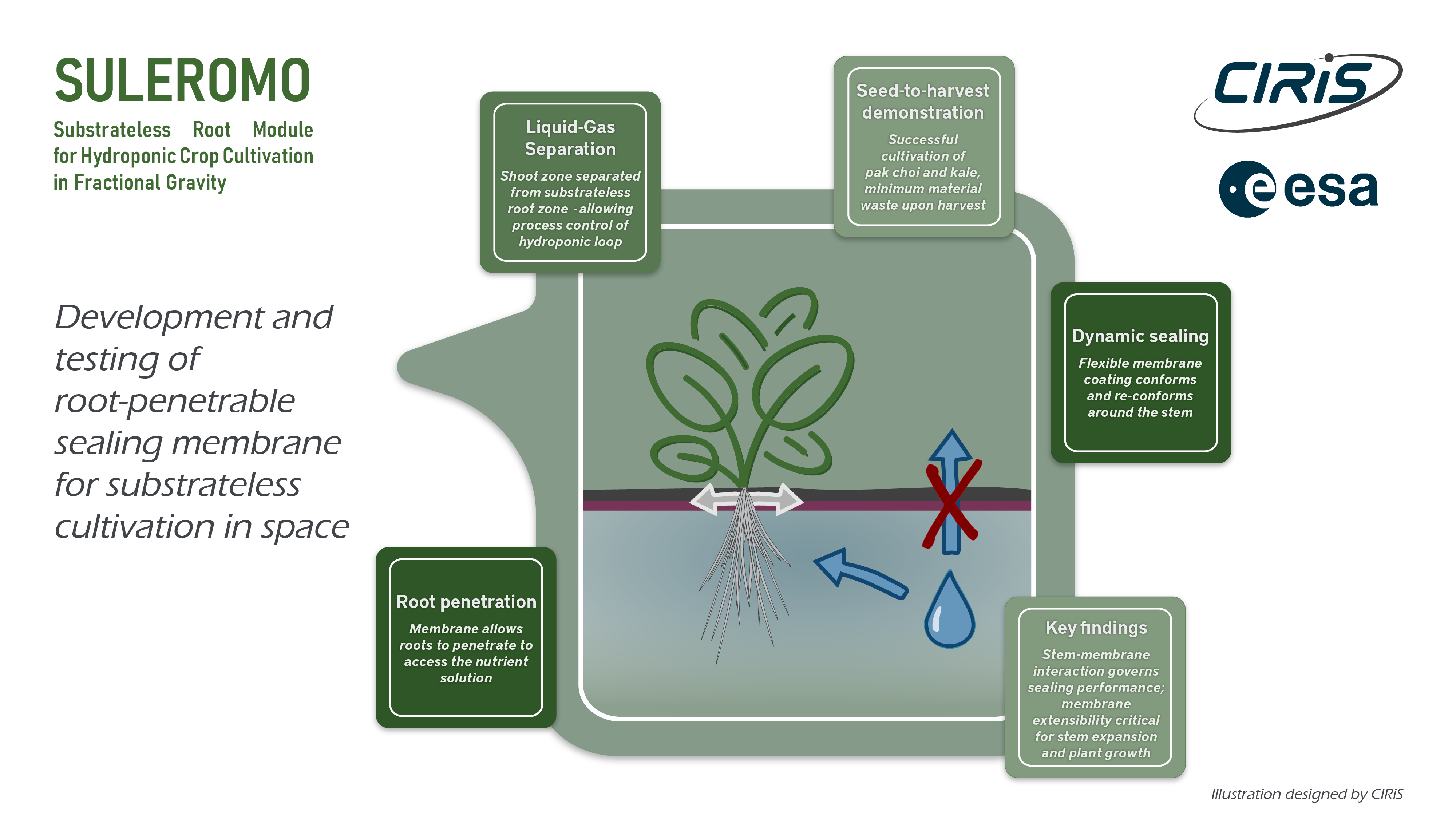
In the SULEROMO project, CIRiS researchers explored whether a specially developed membrane could solve part of this problem.
The membrane was designed to allow roots to grow through it while limiting the movement of water between the plant's root zone and the air above.
To test the concept, the team grew pak choi and kale from seed to harvest over 42 days. Both crops completed their growth cycle successfully, showing that the membrane materials were compatible with sustained plant growth.
– The key question was whether we could support plant growth while also containing the water, says Achim Gerstenberg.
– Our results show that this is possible, although engineering challenges remain.
Now the researchers have much better understanding
The membrane reduced water transfer by approximately 2,000 times compared with an unprotected interface, but it did not achieve complete separation between water and air.
Some leakage was observed during testing, providing valuable information for future development.
– The membrane did not perform exactly as we had hoped, says Gerstenberg.
– But we now have a much better understanding of how such systems behave and what needs to be improved next, he says.
The knowledge gained through the project could contribute to future plant production systems for long-duration space missions and may also be relevant for highly resource-efficient cultivation systems on Earth.